Cinders, mag chloride, or salt: what to put down on mountain ice
What each de-icer actually does, which ones damage pavers and concrete, and why rock salt stops working in Colorado cold long before you need it to.
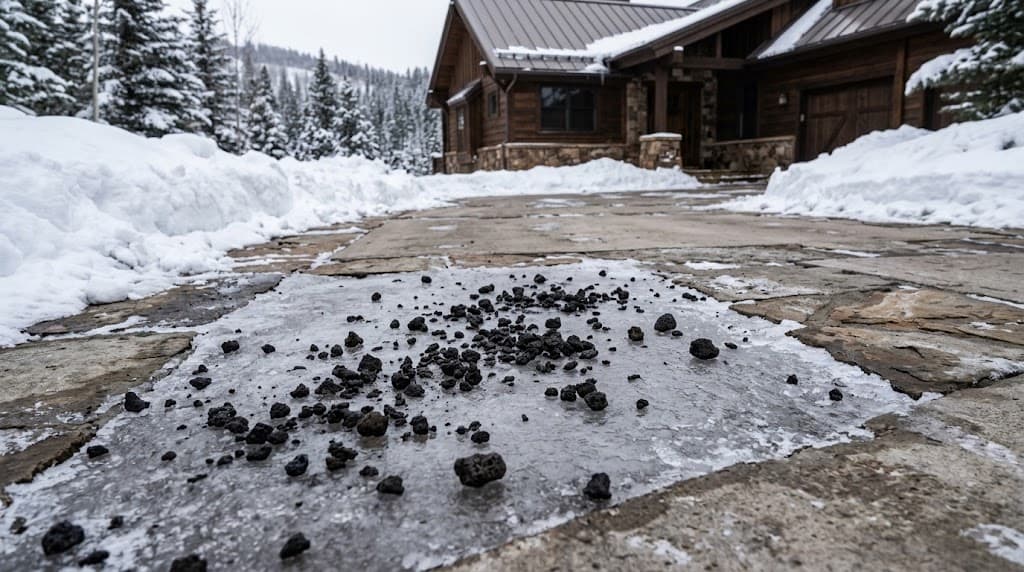
The driveway's plowed, but there's a glazed patch on the grade near the garage and somebody's going to go down on it.
You're standing in the hardware store aisle looking at a blue bag, a white bag, and a pile of what looks like gravel. They all say ice melt. They cost different amounts. Nobody can tell you which one you want.
The short version: these are two different jobs. Salt and mag chloride melt ice. Cinders and sand don't melt anything — they give you grip on top of it. Which one you want depends on how cold it is and what your driveway is made of.
Here's the practical version.
Rock salt — cheap, and it quits early
Rock salt is sodium chloride. It's the cheapest thing on the shelf and it's what most people reach for out of habit.
Two problems up here.
It stops working in the cold. Salt melts ice by lowering the freezing point, but only so far. Its practical floor is somewhere around 20°F — below that it slows down badly, and near 15°F it's basically sitting there. Plenty of Edwards mornings are colder than that. You put it down, nothing happens, and it's still there in the afternoon.
It's hard on everything it touches. Salt accelerates the freeze-thaw cycling that spalls concrete — the surface flaking you see on older driveways and garage aprons. It works into the joints between pavers and lifts them. It kills the grass and shrubs along the edges where meltwater runs off. And it eats at the underside of whatever's parked on it.
On a stamped-concrete driveway or a paver entry, that's an expensive way to save eight dollars a bag.
Magnesium chloride — works colder, easier on the surface
Mag chloride is what the highway departments run, and it's what we use.
It keeps working further down. Mag chloride stays effective into the single digits — well past where rock salt has given up. On a February morning at 8°F, that's the whole difference.
It's less aggressive on concrete and pavers. Less, not none — any chloride works into concrete over time, and anyone telling you otherwise is selling something. But the damage profile is meaningfully gentler than rock salt, which matters on the kind of driveways people build up here.
It pulls moisture from the air, so it keeps working a while after it's down rather than doing its job once and quitting.
Trade-offs: it costs more, and because it attracts moisture it can leave a surface feeling slightly damp or slick-looking when it's working. That's normal.
Cinders and sand — not a de-icer at all
This is the one people misunderstand.
Cinders don't melt anything. Crushed volcanic rock, dark, angular — they sit on top of the ice and give tires and boots something to bite.
Which sounds like less, but it's an advantage in two situations.
When it's too cold for chemistry. At 5°F no de-icer is doing much. Traction still works at any temperature, because it isn't a chemical reaction.
When you don't want chloride on the surface at all. New concrete in its first winter, a paver entry you just paid for, a walkway where meltwater runs into planting beds. Cinders give grip and do nothing to the surface.
The dark color helps too — cinders absorb sun and melt a little pocket into the ice, which locks them in instead of letting them skitter off.
Downside: they don't clear anything, and you sweep them up in the spring.
What we use, and why
Cinders and magnesium chloride. No rock salt.
The reason is the driveways in this valley. Stamped concrete, pavers, flagstone entries, heated aprons — a lot of expensive surface. Rock salt saves a few dollars a season and costs real money in spalled concrete and lifted pavers three winters out. That math doesn't work.
Which one we use depends on the morning. Cold enough that chemistry won't help, or a surface we don't want chloride on: cinders. Ice that needs to be gone rather than survivable: mag chloride.
De-icing is an add-on either way, priced up front and requested when you want it — how that's structured is the same as any other add-on. Plowing is the contract. Treatment is a separate line, because most storms don't need it.
The practical answer
If you're standing in that aisle: mag chloride if the ice needs to go, cinders if it's very cold or the surface is expensive, rock salt basically never up here.
And if the glazed patch keeps coming back in the same spot every winter, that's usually drainage or a roof shedding meltwater onto it, not a de-icer problem. Worth a look before you buy another bag.
If you want the full picture of what's in a seasonal contract versus what's an add-on, here's how snow contracts and pricing work. For association properties where walkways and entries are the liability, that's covered under HOA and association snow removal.
Questions about de-icing
Safer than rock salt, not harmless. Any chloride works into concrete over time. Mag chloride's damage profile is meaningfully gentler, which is why it's the common choice on decorative surfaces — but the best protection is using less of it and only where it's needed.
Its practical floor is around 20°F, and it slows badly below that. Magnesium chloride keeps working into the single digits, which is why it's more useful at altitude.
No. Cinders provide traction on top of ice rather than melting it. That makes them useful when it's too cold for any de-icer to work, or on surfaces you don't want chloride on.
Usually not on a driveway. Pre-treating is a highway and commercial-lot practice. On a residential drive it mostly washes away under the snow. Plow first, then treat what's left.
Usually drainage or roof runoff rather than the de-icer. Meltwater running off a roof or down a grade refreezes in the same place every time. Worth solving at the source instead of treating it all winter.
Tell us about the property.
We reply within one business day with a seasonal price and a proposed scope. Pre-season requests get first spots on the route.